What Happens If Your Property Fails an EICR?
An unsatisfactory EICR result can feel worrying, but it exists to keep you safe. Here is what the codes mean, what happens next, and why you can trust the process.
What Happens If Your Property Fails an EICR?
It is always disappointing when a property does not pass its EICR. Whether you are a landlord relying on a satisfactory result to stay compliant, or a homeowner who expected a clean bill of health, an unsatisfactory outcome can feel stressful and unexpected.
But here is the important thing: the EICR exists to protect you, your family, and your tenants. Electrical safety is our number one priority, and every test we carry out follows the same national standard - BS 7671, the IET Wiring Regulations. The process is not subjective. It is not down to the individual electrician's opinion. The criteria are set out in a national standard that every qualified inspector in the country must follow.
We understand that an unsatisfactory result can raise questions. This article explains exactly what it means, what happens next, and why you can trust the process.
Why Properties Fail
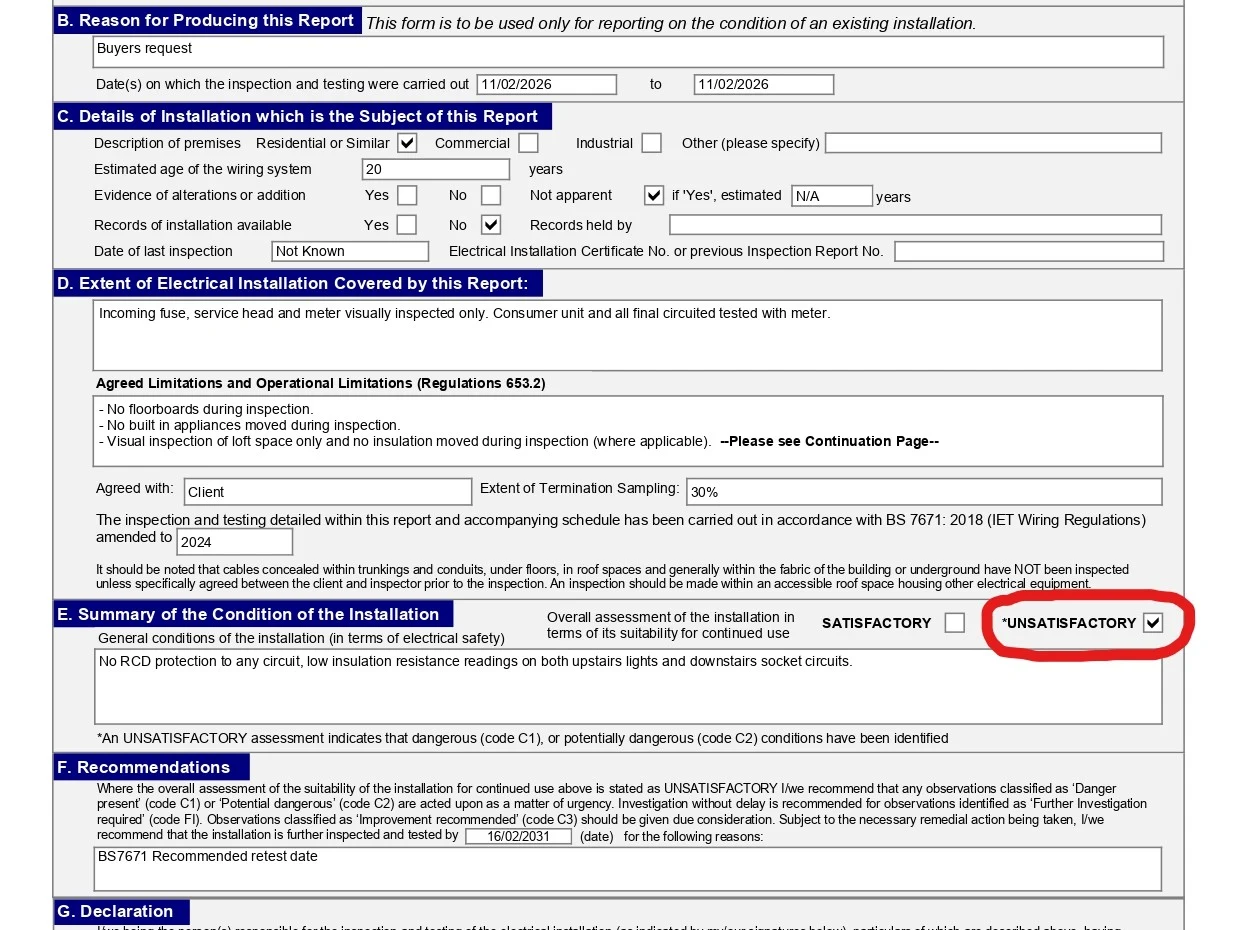
An EICR is not a pass-or-fail exam in the traditional sense. It is a detailed condition report that records every observation about your electrical installation. The overall result - satisfactory or unsatisfactory - is determined entirely by whether any C1 or C2 observations are recorded.
Common reasons a property receives an unsatisfactory result include:
- Lack of RCD protection - Older consumer units without RCD or RCBO devices cannot protect against earth faults, which are a leading cause of electric shocks and electrical fires
- Deteriorated wiring - Rubber or lead-sheathed cables from pre-1970s installations degrade over time and can become a fire risk
- Inadequate earthing or bonding - If the main earthing or supplementary bonding does not meet current standards, it creates a shock risk
- Overloaded circuits - Circuits carrying more load than they were designed for, often from DIY additions or extensions
- Damaged or incorrectly rated protective devices - Fuses or circuit breakers that do not match the cable they protect
- Faulty sockets, switches, or accessories - Physical damage, overheating, or loose connections
Many of these issues develop gradually over years or decades. A property that was perfectly safe when it was built may no longer meet current standards simply due to age and wear.
Understanding the Observation Codes
Every issue found during an EICR is classified using a standardised coding system. These codes are not something we invented - they are defined in BS 7671 and used by every registered electrician in the UK.
A property receives a Satisfactory result only if there are no C1 or C2 observations.
We Are Testing to a National Standard
This is worth emphasising. When we carry out an EICR, we are not making judgement calls or looking for reasons to recommend extra work. We are testing your installation against BS 7671:2018, the 18th Edition of the IET Wiring Regulations. This is the same standard used by every NAPIT, NICEIC, and ELECSA registered electrician in the country.
The testing process itself follows a strict procedure. We measure insulation resistance, earth fault loop impedance, RCD trip times, and continuity of protective conductors. These are objective measurements - the results either meet the required values or they do not. There is no grey area.
If a circuit's insulation resistance is below the minimum threshold, it fails. If an RCD does not trip within the required time, it fails. These are not opinions. They are measurements taken with calibrated instruments against published standards.
We take no satisfaction in delivering an unsatisfactory result. It creates extra work and concern for everyone involved. But we would never overlook a genuine safety issue to give you a result you want to hear. That would put people at risk, and it would be a breach of our professional obligations.
What Happens After an Unsatisfactory Result
If your EICR comes back unsatisfactory, here is what happens next:
For Landlords
Under the Electrical Safety Standards in the Private Rented Sector (England) Regulations 2020, landlords must arrange remedial work for any C1 or C2 defects within 28 days of the report, or sooner if specified. You must then provide written confirmation to your tenants and, if requested, to your local authority.
We understand the time pressure this creates. If your property fails, we prioritise remedial work for landlords to help you stay compliant. In most cases we can complete the repairs and issue the updated certificate well within the 28-day window.
For more detail on landlord requirements, read our guide on landlord EICR requirements.
How Much Does Remedial Work Cost?
The cost depends entirely on what was found. Some common remedial items and their typical costs:
- Consumer unit upgrade (no RCD protection): From £350 - £550
- Earthing and bonding improvements: From £150 - £400
- Replacing a damaged socket or switch: From £60 - £120
- Replacing a section of deteriorated wiring: Varies by length and access
We always provide a fixed-price quote before any work begins. You will never be surprised by the bill.
Can I Get a Second Opinion?
Absolutely. You are entitled to have another registered electrician carry out a separate EICR if you have concerns about the findings. However, because the testing follows a standardised procedure with objective measurements, a second inspection should produce the same or very similar results if carried out correctly.
If you do seek a second opinion, make sure the electrician is registered with a competent person scheme such as NAPIT, NICEIC, or ELECSA, and holds a current inspection and testing qualification.
We Are on Your Side
We know it can feel like a failed EICR means unexpected costs and hassle. But the reality is that the issues existed before we arrived - the inspection simply brought them to light. Identifying and fixing electrical defects now prevents far worse outcomes later, whether that is a fire, an electric shock, or a non-compliance penalty.
At Circuit Works, we are NAPIT registered (registration number 72679) and all our electricians hold current 18th Edition and inspection and testing qualifications. We carry full public liability insurance and stand behind every report we issue.
Our goal is simple: to make sure your property is electrically safe. If it already is, we will tell you. If it is not, we will explain exactly what needs to be done and give you a fair, fixed price to put it right.
Frequently Asked Questions
Book Your EICR
If your EICR is due, or you have concerns about your electrical installation, book your EICR online through our fixed-price booking system. For landlords with multiple properties, check our landlord services for portfolio pricing. Have questions first? See our EICR FAQ or get in touch.
Ready to get started?
Get your free instant quote in under 2 minutes, or get in touch to discuss your requirements.