Moving a Consumer Unit: What Is Involved and What to Expect
Thinking about moving your fuse box? Whether it is for a kitchen redesign or a garage conversion, here is what the job involves, how long it takes, and what it costs.
Moving a consumer unit is one of those jobs that sounds straightforward but has a few more steps than most people expect. Whether you are redesigning a kitchen, converting a garage, or just want the fuse box out of the way, here is what is actually involved.
Why Do People Move Their Consumer Unit?
The most common reason is a kitchen redesign. In a lot of older houses, the consumer unit sits inside a kitchen cupboard. It takes up an entire cupboard, makes it harder to plan worktops and units around it, and kitchen fitters generally do not want to work near it.
Other common reasons include:
- Garage conversions where the consumer unit is on a wall that is being insulated or re-lined
- Extensions that change the layout of the ground floor
- Accessibility where the current location is difficult to reach in an emergency
- Loft conversions where additional circuits are needed and the existing board location makes cable routing awkward
Whatever the reason, the process is the same.
What Is Actually Involved?
Moving a consumer unit is not just a case of unscrewing it from the wall and putting it somewhere else. Here is what the job involves:
1. An EICR First
Before any work starts, we carry out an EICR (Electrical Installation Condition Report) on the existing installation. This tells us the condition of the current wiring, whether any circuits need attention, and helps us plan the most efficient cable routes to the new location.
There is no point moving a consumer unit onto wiring that has problems. The EICR catches anything that needs sorting before we start.
2. A Switch Fused Isolator
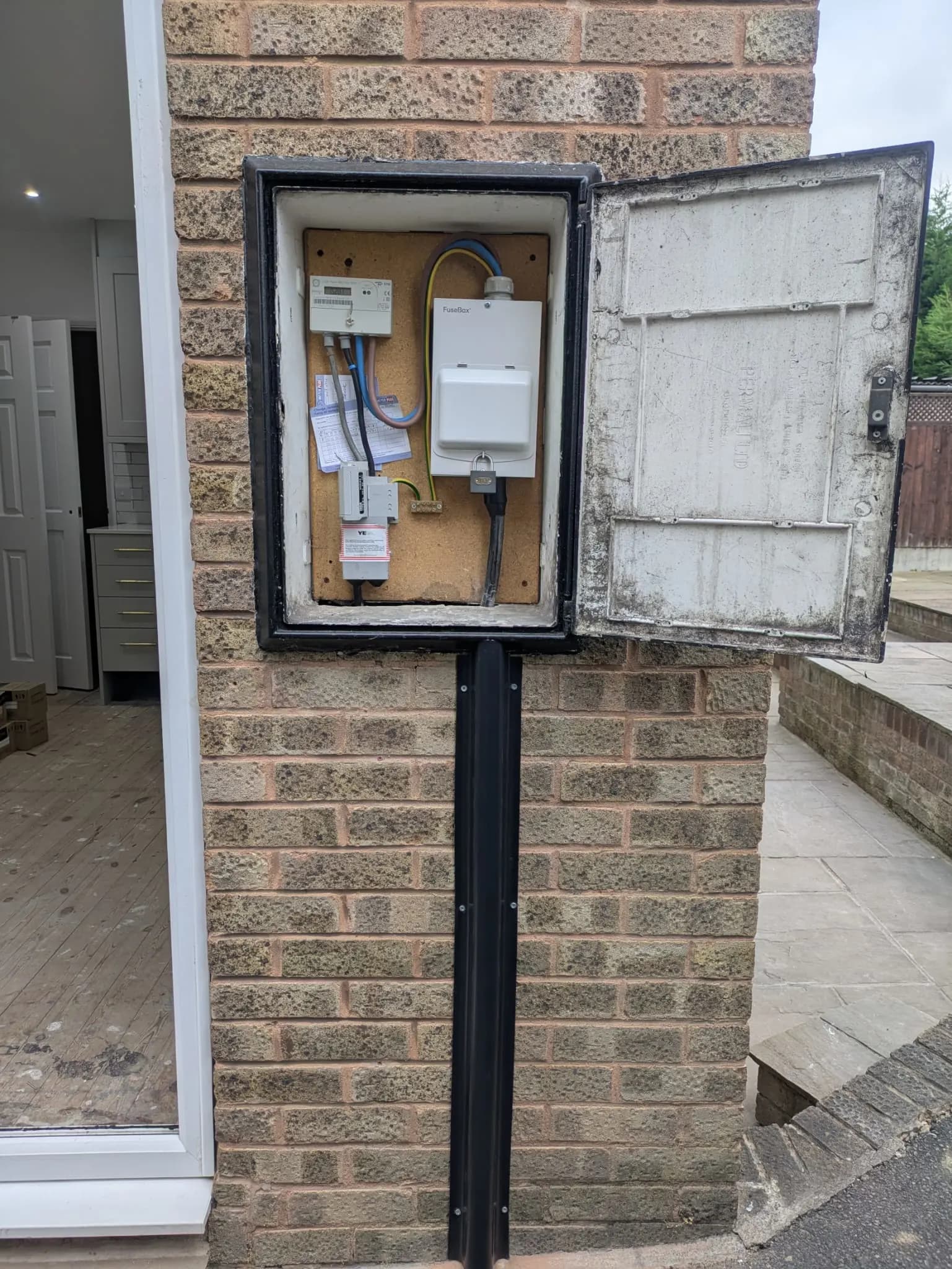
When the consumer unit moves away from the electricity meter, we need to install a switch fused isolator (also called a switched fuse spur or fused switch) next to the meter. This provides a safe point of isolation between the meter and the consumer unit.
The isolator protects the new length of cable between the meter and the consumer unit. It also means you can isolate the entire installation from a single point next to the meter, which is important for safety and for any future work.
3. New Mains Cabling
New meter tails (the thick cables that carry the main supply) need to run from the switch fused isolator to the new consumer unit location. If the distance is over roughly 3 metres, this is a requirement rather than optional, as the DNO (Distribution Network Operator) rules limit how far unprotected meter tails can run.
The type of cable depends on the route. If it is running through walls and floors internally, standard meter tails are fine. For longer runs or routes through areas where the cable could be at risk of damage, SWA (Steel Wire Armoured) cable may be used for extra protection.
4. Extending or Rerouting Circuit Cables
Every circuit cable that currently connects to the consumer unit needs to reach the new location. Depending on how far you are moving it, some cables will be long enough and just need rerouting. Others will need extending or replacing back to the nearest fitting.
Good planning and access to cable routes makes a big difference here. In properties with accessible loft spaces or underfloor voids, rerouting cables is relatively straightforward. In solid-walled or concrete-floored properties, it takes a bit more thought.
5. A New Consumer Unit
When you move a consumer unit, you need a new board that complies with the current BS 7671 wiring regulations. Even if your existing board is only a few years old, the work involved in moving it means fitting a new one is the right approach.
The new unit will have:
- Metal-clad enclosure as required by current regulations
- Individual RCBO protection per circuit (so if one trips, the rest stay on)
- Proper labelling for every circuit
- Surge protection as required by the latest amendments
6. Full Testing and Certification
Once everything is connected and the new board is live, we carry out full testing of every circuit. You get an Electrical Installation Certificate (EIC) confirming the work meets current standards, and we notify Building Control through NAPIT so you do not need to arrange that separately.
How Long Does It Take?
With good access to cable routes and a well-planned job, most consumer unit relocations are completed in a single day. The power will be off for most of the day while we reroute cables and make connections, but by the end of the day everything is live, tested, and certified.
More complex jobs where cable routes are difficult to access or where a lot of circuits need extending can sometimes run into a second day, but that is the exception rather than the rule.
What Does It Cost?
The cost depends on how far the unit is moving and how many circuits need rerouting. As a rough guide:
- Short move (same room, different wall): £1000 to £1,200
- Moderate move (to hallway or under stairs): £1,200 to £1,800
- Longer move (to garage or utility room): £1,500 to £2,500
That includes the EICR, switch fused isolator, new mains cabling, new consumer unit, all circuit rerouting, testing, and certification. We will give you a fixed price after a site survey so there are no surprises.
Can I Do It During a Kitchen Refit?
Absolutely, and this is the best time to do it. If the kitchen is being stripped out anyway, we have clear access to walls, floors, and cable routes that would normally be hidden behind units and worktops. It is quicker, easier, and cheaper than trying to do it with a finished kitchen in place.
The ideal sequence is:
- Kitchen stripped out
- Consumer unit relocated (us)
- Any additional sockets or lighting circuits added (us)
- Plastering and making good
- New kitchen fitted
- Second fix electrics (fitting faceplates and final connections)
If you are working with a kitchen fitter, let us know and we can coordinate timing so there is no delay to the overall project.
Planning Permission and Building Regs
Moving a consumer unit does not require planning permission. However, it is notifiable work under Part P of the Building Regulations, which means it must be carried out by a registered electrician who can self-certify, or inspected by building control.
We are NAPIT registered, so we handle all the certification and Building Control notification. You do not need to arrange anything separately.
Frequently Asked Questions
Ready to get started?
Get your free instant quote in under 2 minutes, or get in touch to discuss your requirements.