Consumer Unit Upgrade: When and Why to Replace Your Old Fuse Box
If you've still got rewirable fuses or no RCD protection, here's why a consumer unit upgrade matters, what it involves, and what it costs.
When and Why to Replace Your Old Fuse Box
Your consumer unit (fuse box) controls every circuit in the house. If it's outdated, it might not protect you properly against electrical faults, fires, or shocks.
What Is a Consumer Unit?
It's the box, usually under the stairs or in a cupboard, where your electricity supply splits into individual circuits. Modern ones have circuit breakers (MCBs) that trip when there's a fault, plus RCDs or RCBOs that detect earth faults and cut the power in milliseconds.
Signs It Needs Replacing
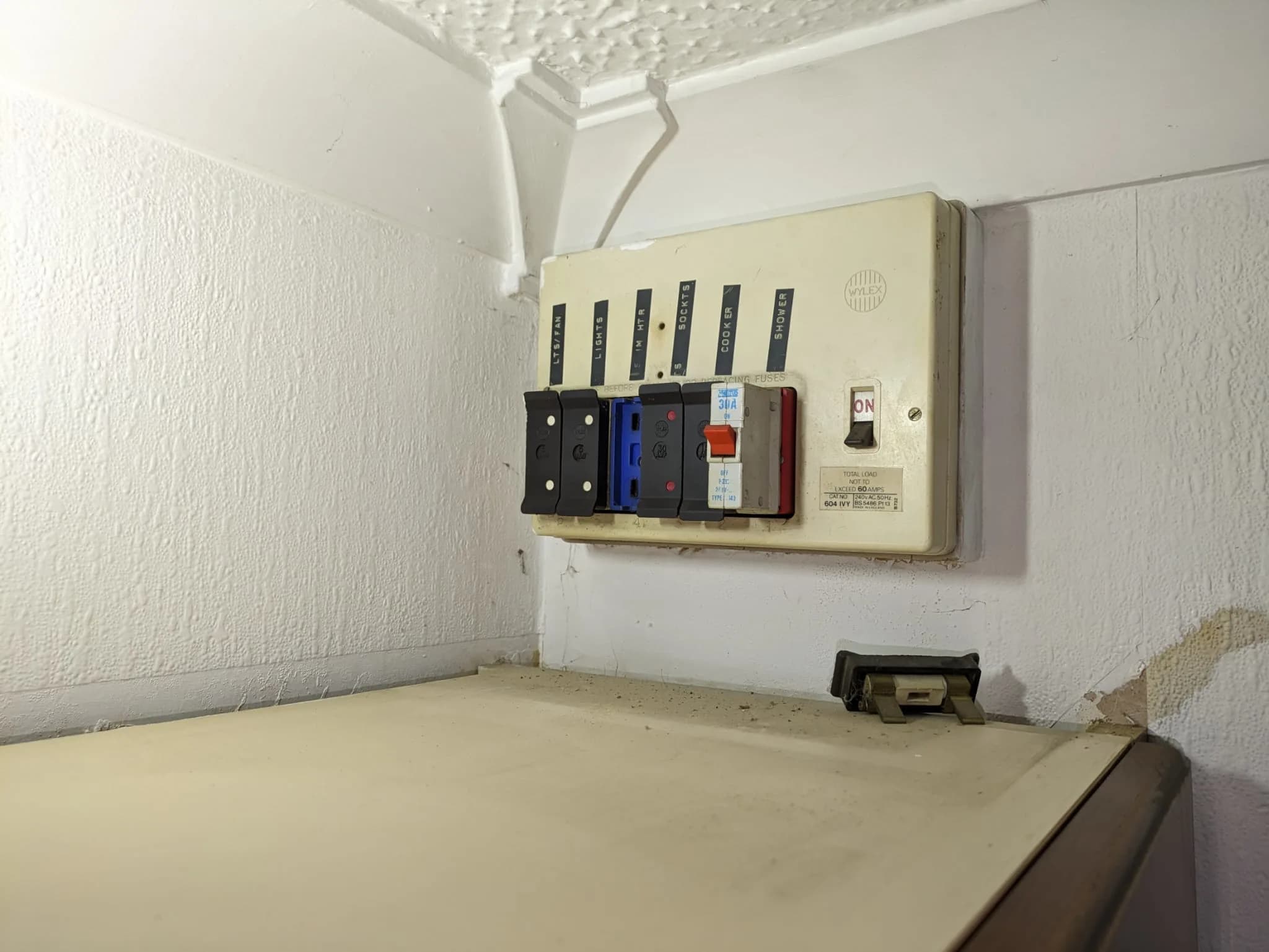
- Rewirable fuses: If you're still replacing fuse wire when it blows, the board is well past its best
- No RCD protection: Without an RCD or RCBO, you've got no protection against earth leakage faults
- Frequent tripping: Usually means the board is overloaded or deteriorating
- Scorch marks or burning smell: Immediate concern. Get it looked at.
- Wooden back board: Fire risk. Modern boards are metal-clad
- Extensions or loft conversions: Extra circuits can overload an undersized board
What We Include in an Upgrade
- Removal of the old board
- New metal-clad consumer unit to BS 7671:2018 (18th Edition)
- Individual RCBO protection per circuit (if one trips, the rest stay on)
- Full testing of all existing circuits
- Electrical Installation Certificate and NAPIT notification to Building Control
- Clear labelling of every circuit
RCDs vs RCBOs
Cost
Between £500 and £800 for a standard 3-bed home. That covers materials, labour, testing, and certification. If the testing shows up wiring problems, we'll tell you before doing any extra work.
How Long?
Usually 6 to 8 hours, done in a single day. The power will be off for most of it. We'll let you know the schedule so you can plan around it.
Do I Need a Registered Electrician?
Yes. Consumer unit replacements are notifiable under Part P of the Building Regulations. The electrician has to be registered with a scheme like NAPIT to self-certify the work. We handle all the paperwork.
Common Questions
How do I know if mine needs replacing? The best way is an EICR. That'll flag any issues with the board. You can also look for obvious signs: rewirable fuses, wooden back board, scorch marks, or no RCD test button.
Can I upgrade the board without a full rewire? Usually, yes. If the existing wiring passes the testing we do during the upgrade, a standalone board swap works fine. If the wiring is in poor condition, we'll let you know and talk through options.
How disruptive is it? Not very. The work is around the consumer unit area. Power's off for most of the day, but it's confined to one visit.
Do I need Building Regulations approval? Yes, but we handle that. As a NAPIT registered contractor, we self-certify and notify Building Control directly.
What's the difference between an MCB, RCD, and RCBO? MCB protects against overloads and short circuits. RCD protects against earth faults (electric shocks). RCBO does both in one device, per circuit. We fit RCBO boards so that if one circuit trips, everything else stays on.
Get a Quote
Contact us for a free assessment and fixed-price quote. We cover Pontefract, Wakefield, Leeds, and West Yorkshire. More on our FAQ page.
Ready to get started?
Get your free instant quote in under 2 minutes, or get in touch to discuss your requirements.